




Ask contractors what eats their evenings and estimates come up fast. One owner on r/Contractor described spending about an hour per estimate after a full day on site—and still losing bids because the quotes went out too slowly. Another thread, titled simply "Bidding is killing me," is full of the same frustration: hours of unpaid work, followed by silence.
A contractor estimate is not just paperwork. It is the document a homeowner uses to decide whether they trust you with their home and their money. This guide explains how to write a contractor estimate that is fast to produce, easy to approve, and protective of your margin—with notes for contractors working in Canada. It's general information, not legal advice. Before you rely on any contract wording, deposit limit or cancellation term, check it against the consumer protection rules in your province or talk to a lawyer.
Estimate vs. Quote: Know What You Are Promising
Many trades use the two words interchangeably, but they signal different things. An estimate is your best approximation of the cost based on what you know today. A quote is usually a fixed price for a clearly defined scope. In practice, the scope and terms written on the page matter more than the label at the top.
Provincial consumer protection rules can also shape what an estimate means. In Ontario, for example, the province states that if your customer contract includes an estimate, you can't charge more than 10 per cent above that estimate unless the customer agrees to the additional charges, and it recommends a revised written estimate that you both sign if the project changes in a major way. The rule is set out in section 10 of Ontario's Consumer Protection Act, 2002, which also lets you and the customer amend the estimate when they ask for additional or different work. Rules differ by province, so confirm the requirements where you work.
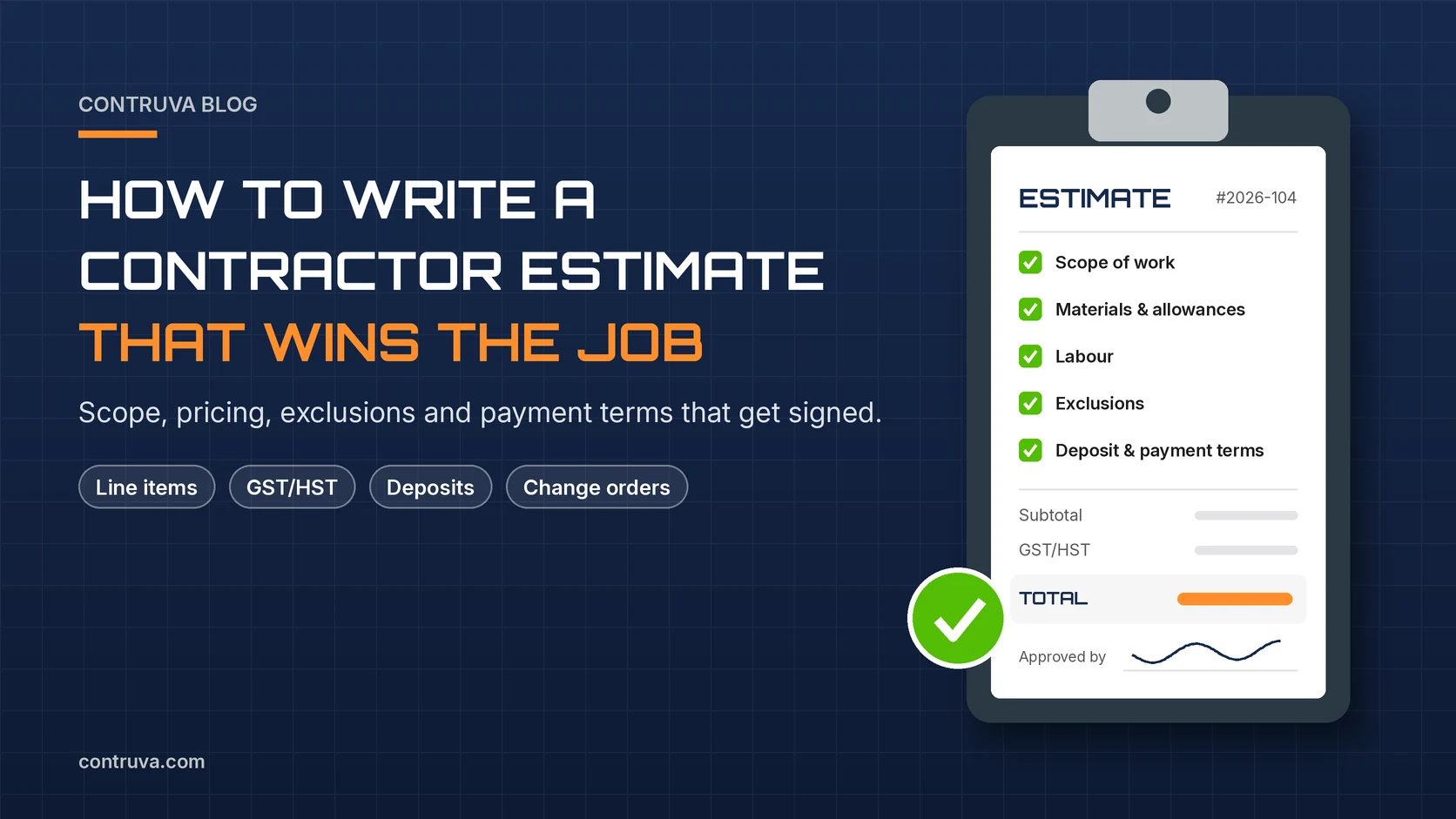
The Nine Parts of an Estimate That Gets Approved
- Your business details: legal business name, phone, email, address, and your GST/HST number if you are registered.
- Customer and property: the customer's name, contact information, and the job site address.
- Estimate number, date, and expiry: material prices and your schedule change, so state how long the price is valid.
- Scope of work: a plain-language description of the work, organized by area or phase.
- Pricing and totals: grouped by phase or area so the customer understands what they are paying for.
- Materials and allowances: named products where they are decided, and allowance amounts where the customer still has selections to make.
- Exclusions and assumptions: what is not included and what conditions the price depends on.
- Schedule assumptions: estimated duration and what the start date depends on—permits, materials, weather, or customer selections.
- Payment terms and approval: deposit, progress payments, balance due, a change-order clause, and a clear way to accept.
"Most estimate disputes start with a vague scope, not a high price. Write the job so clearly that a stranger could read it and know exactly what you are building."
Contruva
Write a Scope That Prevents Arguments
When one contractor posted an estimate for feedback on r/Contractor, the most common advice was the same: put far more detail into the scope, and stop showing the markup. The customer needs to understand what is being done—not how your costs are built.
Weak scope vs. strong scope
- Weak: "Replace bathroom fan."
- Strong: "Remove existing bathroom exhaust fan. Supply and install new fan (model or allowance listed below). Connect to existing duct and switch. Patch drywall around the new housing. Painting by others."
The strong version answers the questions that cause disputes later: who supplies the fan, what happens to the ceiling, and who paints.
Put hidden conditions in writing
For renovation work, state that the price is based on visible conditions at the time of the site visit. Explain that anything discovered behind walls, under floors, or above ceilings will be documented, priced, and approved in writing before that work continues. A short, specific exclusions list builds more trust than a page of boilerplate.
Price It So You Still Make Money
A professional-looking estimate is worthless if the number underneath it is wrong. Build every price from the same components:
- Materials: current supplier pricing plus your markup.
- Labour: estimated hours multiplied by a rate that covers wages, payroll costs, and non-billable time.
- Job costs: equipment rentals, disposal, permits, travel, and subcontractors.
- Overhead: insurance, vehicles, software, office, and marketing, spread across your billable work.
- Profit: a deliberate margin, not whatever is left over.
After each job, compare actual hours and materials with what you estimated. Those numbers make the next estimate faster and more accurate. And keep perspective on your win rate. As one r/Contractor commenter put it: "Winning everything means you're too cheap. Losing everything means you're too high or bidding wrong customers."
GST/HST and Deposits on Canadian Estimates
If you are registered for GST/HST, show the tax on the estimate so the number the homeowner approves is the number they will pay. The CRA's rules for charging and collecting GST/HST require you to tell customers whether tax applies and to show the rate and the tax amount separately (or state clearly that the total includes it); for HST, show the combined rate rather than splitting the federal and provincial parts. If you are not registered yet, know where the line is: under the Canada Revenue Agency's rules, you are generally a small supplier while your worldwide taxable revenues stay at or below $30,000 in a single calendar quarter and over four consecutive calendar quarters. Once you exceed that threshold, you have to register and start charging GST/HST.
For deposits, put the amount and the due date directly on the estimate so payment terms are approved together with the price. QuickBooks Canada notes that many trades ask for 25% to 50%, especially when materials must be purchased up front. Check your provincial rules before setting a deposit policy.
Send Faster With a Budget Range First
A detailed estimate for a large project can take hours. Before you invest that time, confirm the homeowner's budget fits the job. One contractor in the same r/Contractor estimates thread sends a "budgeting estimate" within 48 hours of the site meeting: a short note with a realistic range, and an offer to prepare a detailed quote if the range works.
That approach filters out poor-fit projects early and keeps serious customers engaged. Pair it with reusable templates for your most common jobs—standard scope language, exclusions, and payment terms—so each detailed estimate starts most of the way finished. Speed matters here just as it does with first contact; see our guide to speed to lead for contractors.
Follow Up Until You Get a Clear Answer
Sending the estimate is the midpoint of the sale, not the end. Give every open estimate an owner and a next-action date:
- Day 1–2: confirm the customer received it and ask whether anything in the scope is unclear.
- Day 5–7: follow up on questions, selections, or timing.
- Before expiry: remind the customer when the price is valid until and what happens to the schedule.
Track estimate rate and close rate by lead source, too. It shows which channels produce work you actually win—the foundation of useful contractor marketing attribution.
Where Contruva Fits
Contruva is built for the trades. It brings customer records, deal tracking, professional quotes, schedules, tasks, and expenses into one platform. The details you capture on the first call are already there when you build the quote, and every open estimate stays visible in the pipeline until it is won or lost. Learn more in our guide to all-in-one contractor software.
Frequently Asked Questions
What should a contractor estimate include?
Include your business and customer details, an estimate number, date, and expiry, a detailed scope of work, pricing and totals, materials and allowances, exclusions and assumptions, schedule assumptions, and payment terms with a change-order clause and a clear way to approve.
Should contractors show markup on an estimate?
Generally, no. Show the customer what is included and what each phase or area costs, but keep your internal markup and cost structure private. Visible markup invites line-by-line negotiation instead of a decision about value.
How long should a contractor estimate be valid?
Set an expiry that reflects how quickly your material prices and schedule change, and print it on every estimate. A clear expiry protects your margin and gives you a natural reason to follow up.
Better estimates win more of the work you already earned. Join the Contruva waitlist to bring customers, deals, quotes, schedules, tasks, and expenses into one connected workflow.
Recent Posts