




If you hire subcontractors on Ontario construction jobs, or you are the sub waiting on a GC to let you start, the WSIB clearance certificate is the document that keeps everyone moving. Without one, the principal can be on the hook for unpaid WSIB premiums, and starting work without a valid clearance is an offence for both sides. This guide covers what a clearance is, when you need one, how long it lasts, and how to stay eligible so jobs do not stall at the gate.
It is general information for Ontario contractors and subcontractors, not legal advice. For your account status or a specific job, use the WSIB clearance FAQs and online services, or talk to your advisor.
What Is a WSIB Clearance Certificate?
According to the WSIB, a clearance is a number that shows a business is registered and up to date with the WSIB, including premium reporting and payment. For the person or company hiring the contractor (the principal), that clearance also relieves them of liability for unpaid premiums and other amounts the contractor might owe the WSIB during the clearance validity period.
In plain terms: a clearance is proof the contractor's WSIB account is in good standing for the dates on the certificate. GCs and property managers ask for it before you mobilize. If you hire your own trades, you become the principal for those subs and need their clearances too.
When Do Ontario Contractors Need One?
Under the WSIB's Clearance Certificate in Construction policy, a principal who directly retains a contractor for construction work must obtain a clearance before that work starts, and keep a valid clearance in place for the entire job. Starting construction without a clearance is an offence for both the principal and the contractor.
That chain continues down the stack. If you hire a sub to dig, rough-in, or finish, you are the principal for that sub. You must get their clearance before they start and keep it current for as long as they are on site. Delivery drivers, equipment techs, and other visitors who are not contractors working for a principal do not need a clearance, per the WSIB's FAQ.
The home renovation exemption
There is a limited exemption. The WSIB says a clearance is not required when a home's resident, occupant, or a family member hires a contractor for home repairs or renovations on that private residence. The exemption does not flow down to subcontractors you bring onto that job; those subs are not hired directly by the homeowner, so they still need coverage and a clearance when you retain them. Confirm the details in the WSIB's expanded compulsory coverage policy if your work sits near that line.
What "Good Standing" Means
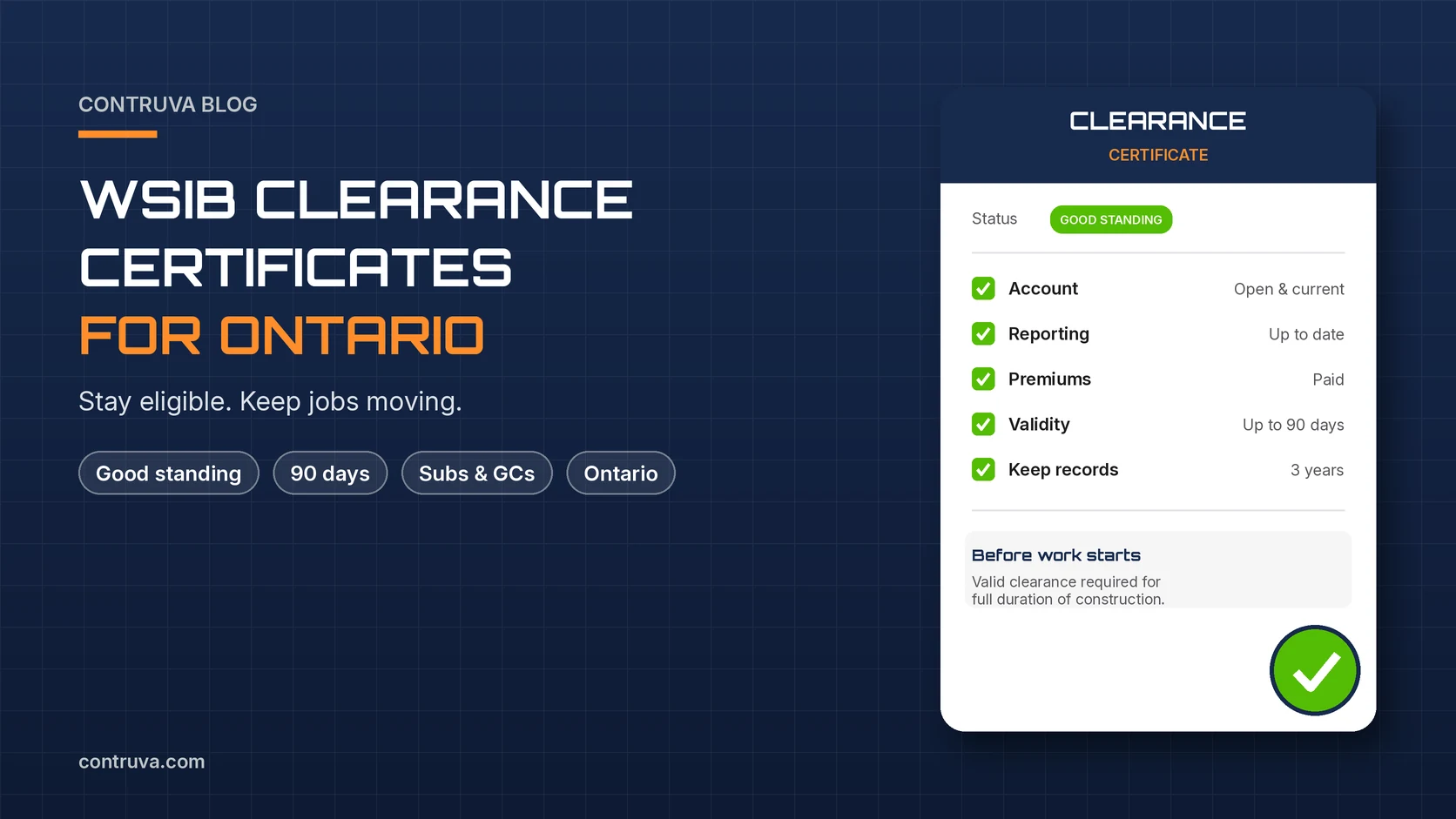
You only get a clearance when your account is in good standing. The WSIB's construction clearance policy lists the bar clearly. In practice, that means:
- You have an open WSIB account with complete registration information and documents.
- Your business activities are in the right classification codes.
- You have reported premiums based on actual or estimated insurable earnings for all past reporting periods.
- Required Premium Remittance and Reconciliation Forms are filed.
- All premiums and other amounts owing are paid up to date when the clearance is requested (interest, service charges, experience rating surcharges, adjustments, and non-compliance charges count).
If you have more than one account, each one must meet those requirements before a clearance is issued for any of them. Newly registered businesses that need a clearance at registration usually make an initial advance payment of $250, which the WSIB applies as a credit toward future premiums. Clearances themselves are free.
"An 'ineligible' clearance status is almost always a reporting or payment problem, not a mystery. Fix the account first; the certificate follows."
Contruva
How Long Is a Clearance Valid?
Clearances are valid for up to 90 calendar days from the date of issue, and they are renewable. The WSIB notes that most clearances expire on the 20th of February, May, August, and November. If the job runs longer than the validity window, you need a new clearance for the remaining period. The WSIB will automatically issue a new one when the account stays in good standing.
Principals and contractors must keep records of clearances for at least three years from the date they were obtained. Treat that like any other job file: save the PDF with the contract, change orders, and invoices so you can produce it if asked.
How to Get or Check a Clearance
The fastest path is the WSIB's online services. You can use quick access clearances without logging in to find, view, and download your own clearances. With a logged-in online services account you can build contractor lists, view clearance history, search current clearances, and set reminder emails. You can also request a clearance by email and typically receive it within three to five business days.
To check a contractor you hired, search by business name, phone, CRA business name, address, city, or postal code in the online tool. If they show as ineligible, they need to bring their account current before a clearance can be issued. Do not start them on site while that is unresolved.
What Happens If You Skip It?
Without a clearance, the principal may be liable for the contractor's unpaid WSIB amounts, up to the labour portion of the contract. Starting construction without a valid clearance, failing to renew an expired or revoked one, or failing to keep records can all be offences under the Workplace Safety and Insurance Act. The WSIB's clearance FAQ states that the maximum fine for a conviction of an offence under the WSIA is $100,000.
Contractors also have duties: advise the principal if a clearance is revoked, and do not perform construction work for a principal without a clearance. On commercial and multi-trade jobs, missing paperwork is how schedules and draws get held up. Build clearance checks into your pre-start checklist the same way you check insurance and scopes.
A Practical Clearance Workflow for GCs and Subs
- Before you bid or accept. Confirm your own account is current so you can produce a clearance on request. If you are hiring trades, list every sub who will do construction work.
- Before mobilization. Pull or verify each sub's clearance. Save the certificate number and expiry with the job file. Do not let anyone start until it is valid for the start date.
- During the job. Watch expiry dates, especially around the February, May, August, and November renewals. If a job spans a renewal, get the next clearance before the old one drops.
- After the job. Keep the clearance records for at least three years with the contract and invoices.
When you send a quote or kickoff package, attach your current clearance alongside insurance certificates. Clean paperwork speeds approvals the same way a clear scope speeds sign-off. Our guide on how to write a contractor estimate covers the commercial details clients expect on the pricing side; clearance and insurance belong in the same professionalism stack.
Where Contruva Fits
Contruva keeps customers, quotes, schedules, tasks, and job expenses together for Canadian trades. When every sub, start date, and document lives on the same job record, clearance renewals are easier to track before someone shows up on site without paperwork. See how that connects in our guide to all-in-one contractor software, and how GST/HST on materials and invoices fits the same ops picture in do contractors charge HST on materials.
Frequently Asked Questions
What is a WSIB clearance certificate?
It is a number issued by the WSIB showing that a business is registered and in good standing with premium reporting and payment. For the principal who hired the contractor, it also relieves liability for unpaid WSIB amounts the contractor may owe during the clearance validity period.
Do Ontario contractors always need a clearance for construction work?
Yes for construction work between a principal and a contractor: a clearance must be in place before work starts and for the full duration. An exemption applies when a home's resident or family member directly hires a contractor for home renovations on that private residence; subcontractors retained by that contractor still need clearances.
How long is a WSIB clearance valid?
Up to 90 calendar days from the date of issue. Most clearances expire on the 20th of February, May, August, and November. If the job lasts longer, obtain a new clearance for the remaining period. Keep records for at least three years.
What if a contractor is marked ineligible for a clearance?
Ineligible usually means the account is not up to date on reporting or payment. The contractor must bring the account into good standing before the WSIB will issue a clearance. Do not start construction work until a valid clearance is in place.
Get your quotes, jobs, and expenses working together. Join the Contruva waitlist to bring customers, deals, quotes, schedules, tasks, and expenses into one connected workflow.
Recent Posts