


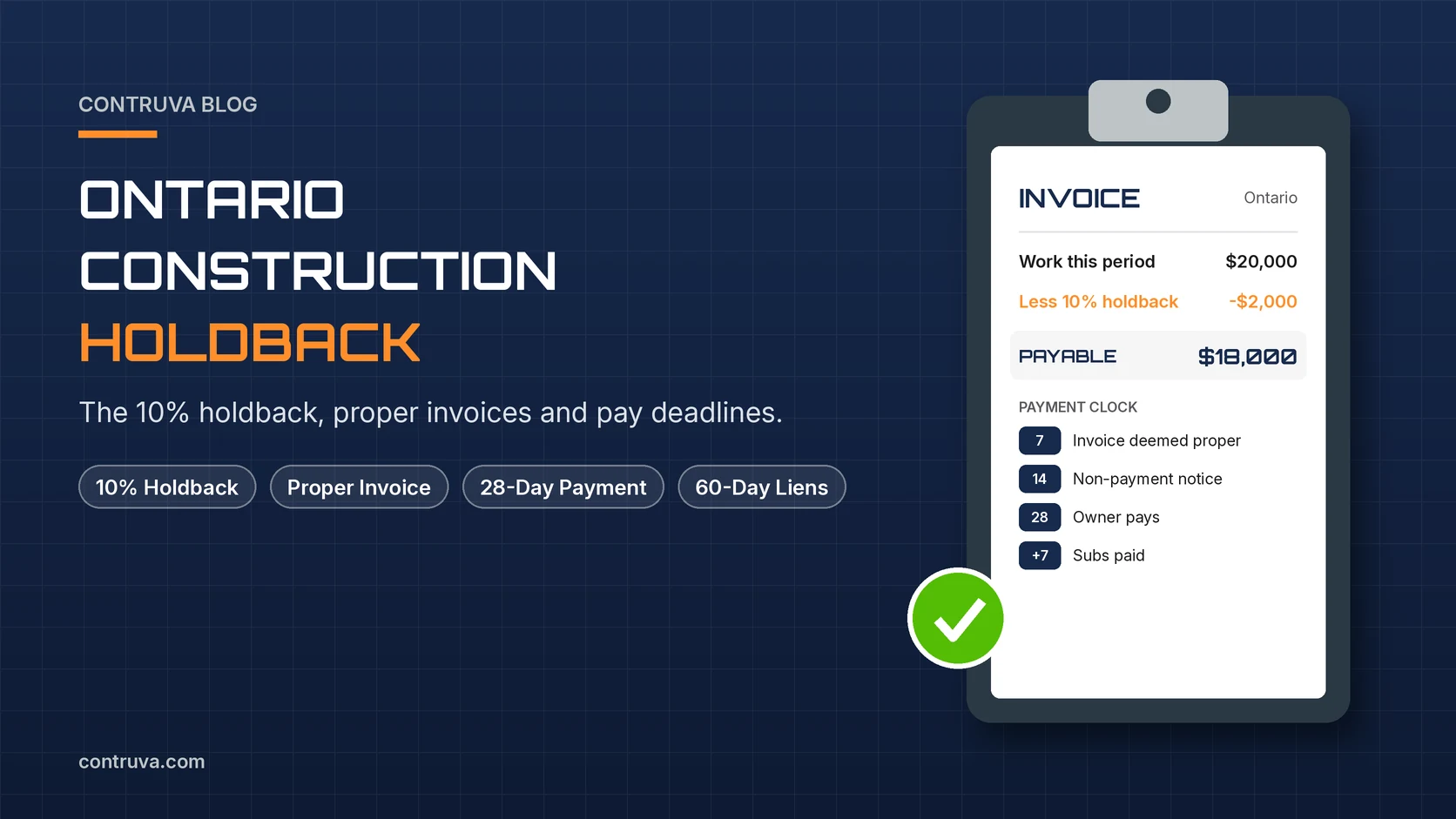
If you do renovation or construction work in Ontario, two parts of the Construction Act decide how fast you actually get paid: the 10% holdback and the "proper invoice" rules that start the prompt payment clock. Homeowners on Reddit regularly ask whether they really have to hold back 10% when their contract never mentions it. You should know the answer before your customer asks.
Here's what the holdback is, when it gets released (including the annual release rules that started January 1, 2026), what a proper invoice needs, and the payment deadlines that follow. It's general information, not legal advice. For a specific contract or dispute, talk to a construction lawyer.
What Is the Construction Holdback in Ontario?
Section 22 of the Act says every payer on a contract or subcontract where a lien can arise has to keep back 10% of the price of the services or materials as they're actually supplied. That money stays held until every lien that could be claimed against it has expired or been dealt with. It applies whether you bill in progress payments or once at the end.
It runs down the whole chain. The owner holds 10% from the general contractor, the GC holds 10% from each sub, and so on. That way there's money set aside if someone lower down doesn't get paid and liens the property.
- You can't contract out of it. Under sections 4 and 5, an agreement that the Act doesn't apply is void, and every contract is deemed amended to comply. A contract that says nothing about holdback still has one.
- It covers residential work. The Act applies to "improvements," which include alterations, additions and capital repairs. Routine maintenance doesn't count.
- It's trust money. Since January 1, 2026, the Act's trust provisions expressly include holdback, and section 8.1 requires contractors and subs to keep written records of project money in and out.
A Quick Example
You're the GC on a basement finish and you bill $20,000 for this month's work, before tax. The owner pays $18,000 and holds $2,000. If your drywall sub's share was $6,000, you pay them $5,400 and hold $600. The holdback adds up with every invoice, so track it per job from day one. (Tax is its own question. See whether contractors charge HST on materials.)
When Does the Holdback Get Released?
After the 60-Day Lien Period
A contractor's lien expires 60 days after the earlier of these two dates: publication of a certificate of substantial performance, or the contract being completed, abandoned or terminated (section 31(2)). Once the liens have expired or been dealt with, section 26(8) gives the owner 14 days to pay the holdback. The contractor then has 14 days to pay subs their holdback, and each sub has 14 days to pay the next tier.
A contract is deemed completed when what's left to finish costs no more than the lesser of 1% of the contract price or $5,000 (section 2(3)). On most small residential jobs, completion is what starts the clock.
New in 2026: Annual Holdback Release
For long jobs, the new section 26 requires the owner to publish a notice of annual release of holdback (Form 6) within 14 days after each contract anniversary. O. Reg. 304/18 says it goes on a construction trade news website. The owner then pays the past year's holdback 60 to 74 days after the notice, unless a lien has been preserved or perfected, and the contractor passes the subs' share down within 14 days.
For contracts signed before 2026, the first annual release happens on the second contract anniversary after January 1, 2026 (section 87.4). The Ontario Association of Architects notes that in practice, annual releases start in 2027. Loopstra Nixon adds that lien deadlines haven't changed. If your jobs run weeks, not years, you'll rarely see an annual release.
What Counts as a "Proper Invoice"?
Ontario's prompt payment rules run off a "proper invoice." Under section 6.1, it's a written bill that includes:
- Your name and address.
- The invoice date and the period or milestone it covers.
- A contract, line item or purchase order reference.
- A description of the services or materials supplied, with quantities where it makes sense.
- The amount payable and the payment terms.
- The name, title, mailing address and phone number of whoever payment goes to.
- Anything else the contract requires, or that the owner reasonably needs for their accounts payable.
Proper invoices go out monthly unless the contract says otherwise. A clause saying you can't invoice until the owner or a payment certifier approves your work first has no effect (section 6.3). Since January 1, 2026, an invoice is deemed proper unless the owner tells you in writing within 7 days what's missing (section 6.1(2)).
One habit that helps: put the holdback on its own line on every invoice, with the running total held to date. If your estimates already break out scope and line items, as in our guide on how to write a contractor estimate, your invoices can follow the same structure.
Prompt Payment Deadlines
Once a proper invoice is in, the clocks start. Every payment is still subject to holdback (section 6.2).
- Owner pays within 28 days of receiving the proper invoice (section 6.4(1)).
- A dispute needs notice within 14 days. To withhold any part, the owner must give a notice of non-payment in the prescribed form with the amount and every reason. The undisputed part is still due on day 28.
- You pay subs within 7 days of getting paid, for their work on that invoice (section 6.5(1)).
- If the owner doesn't pay, you still owe subs by day 35, unless you give them a notice of non-payment with an undertaking to start adjudication within 21 days.
- Late amounts earn interest at the prejudgment rate, or the contract rate if that's higher (section 6.9).
If a payment is disputed, either side can go to adjudication through ODACC, which is faster than court. The adjudicator generally decides within 30 days of getting the documents, and the paying party has 15 days to pay. If they don't, you can suspend work (sections 13.13 and 13.19). ODACC notes the prompt payment and adjudication rules came into force on October 1, 2019.
A Quick Holdback and Invoicing Checklist
- Record the contract date on every job.
- Invoice on schedule with every proper invoice item, and log the date you sent it.
- Mark day 7, day 14 and day 28 on your calendar.
- Show holdback on each invoice and keep a running total per job.
- Hold 10% from your own subs, and pay them within 7 days of getting paid.
- Write down the completion date, then follow up on holdback once 60 + 14 days have passed.
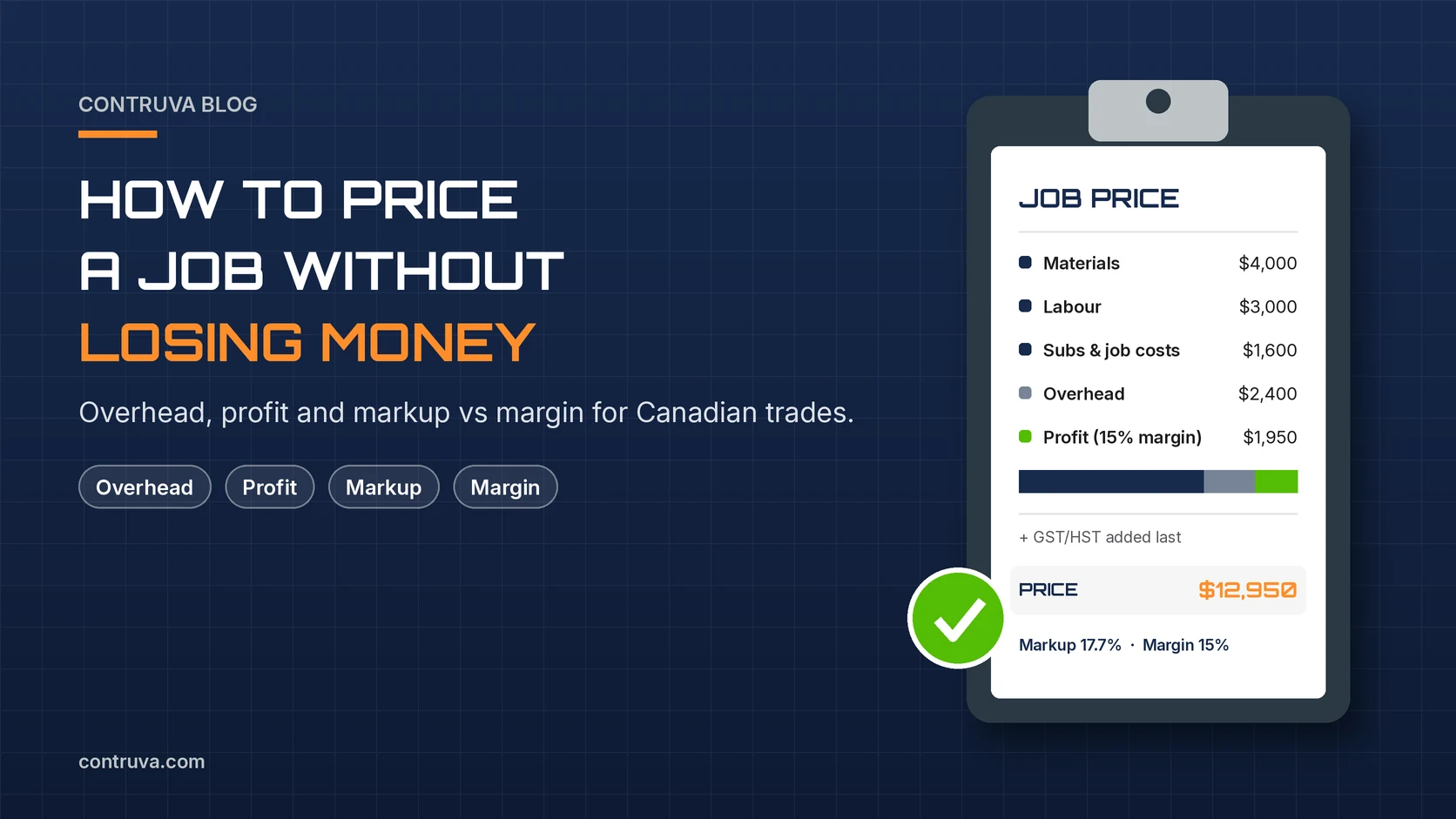
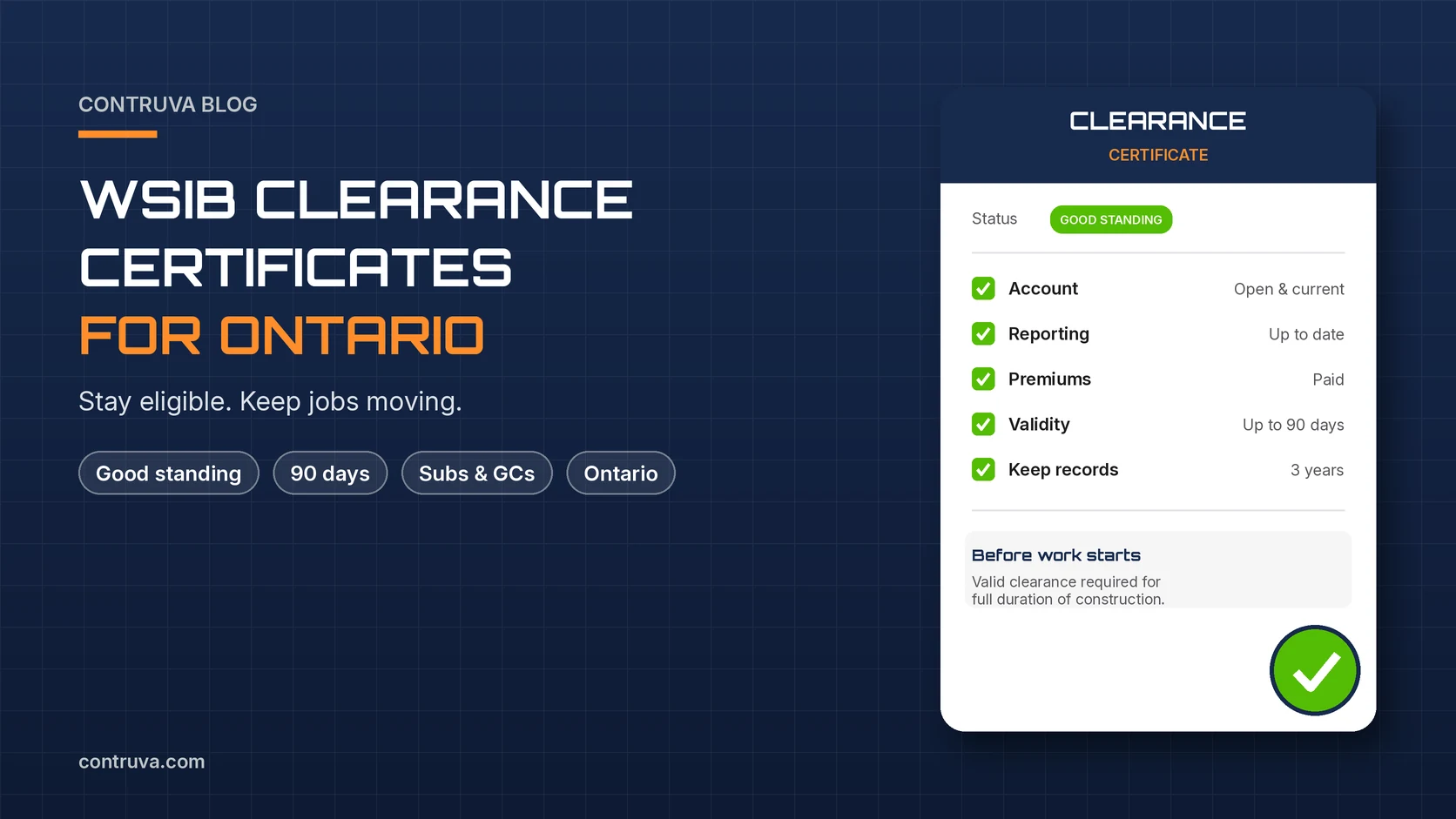
Getting paid on time starts with a good price, so read how to price a job as a contractor if you haven't yet. For Ontario jobs with subs, check WSIB clearance certificates before anyone starts work.
Where Contruva Fits
We're building Contruva so Canadian trades can keep customers, quotes, schedules, tasks and job expenses in one place. When your quotes, jobs and expenses are all on the same customer record, you can see what each job has brought in and what's still owed without digging through spreadsheets at month-end.
Frequently Asked Questions
Does a homeowner have to hold back 10% from a contractor in Ontario?
Generally, yes. The Construction Act requires every payer on a contract where a lien can arise to keep back 10% of the value of the work and materials as they're supplied. That includes homeowners paying for renovations that count as improvements. A contract can't waive it.
How long is the construction holdback kept in Ontario?
Until the 60-day lien period ends. It starts at the earlier of publication of a certificate of substantial performance or the contract being completed, abandoned or terminated. If no liens are preserved, the owner then has 14 days to pay. Long contracts signed from 2026 on also have annual release.
What is a proper invoice under the Construction Act?
A written bill with your name and address, the date and billing period, a contract or PO reference, a description of the work, the amount and payment terms, and who payment goes to. Since 2026, it's deemed proper unless the owner flags a problem in writing within 7 days.
How long does an owner have to pay a proper invoice in Ontario?
28 days from receiving it. To dispute any part, the owner must give a notice of non-payment within 14 days that states the amount and reasons. The contractor then pays subs within 7 days of being paid.
Want quotes, jobs and expenses working together? Join the Contruva waitlist to bring customers, deals, quotes, schedules, tasks, and expenses into one connected workflow.
Recent Posts